Home Improvement · Safety Guides
Pool Fence Guide: How to Choose One and Meet Safety Codes
A pool fence is one of the small number of home improvements that's both legally required in most places and genuinely one of the most effective layers of drowning prevention for young children. The exact rules vary by state and city, but most are built on the same handful of common-sense requirements. Here's what those are, and how to choose a fence that actually meets them.

Why pool fencing is required
Drowning is widely recognized by public health and child-safety organizations as one of the leading causes of unintentional death among young children, and a compliant physical barrier around a residential pool is consistently identified as one of the most effective single layers of prevention — more reliable than supervision alone, which can lapse for even a few seconds. That's the reasoning behind why most jurisdictions don't treat pool fencing as optional the way a decorative yard fence is.
Common pool fence code requirements
- Minimum heightCommonly 48 inches (4 feet), measured from the ground on the side away from the pool; some jurisdictions require more.
- Maximum gap spacingTypically no more than 4 inches between vertical members, and no more than 4 inches of clearance between the bottom of the fence and the ground.
- Non-climbable designHorizontal rails or footholds on the outward-facing side are often restricted or spaced to discourage a child from climbing.
- Self-closing, self-latching gatesGates must automatically close and latch, with the release mechanism mounted high enough to be out of a young child's reach — commonly around 54 inches.
- Full isolation from the houseThe barrier must separate the pool from the home and yard, without gaps at the house wall; if a house wall forms part of the barrier, doors leading directly to the pool area often need an alarm or approved alternative safeguard.
These reflect provisions commonly found in model codes such as the International Swimming Pool and Spa Code (ISPSC) and IRC Appendix G, which many but not all states and cities adopt, sometimes with local amendments. Treat this as a starting checklist, not a substitute for your local code.
Types of pool fencing
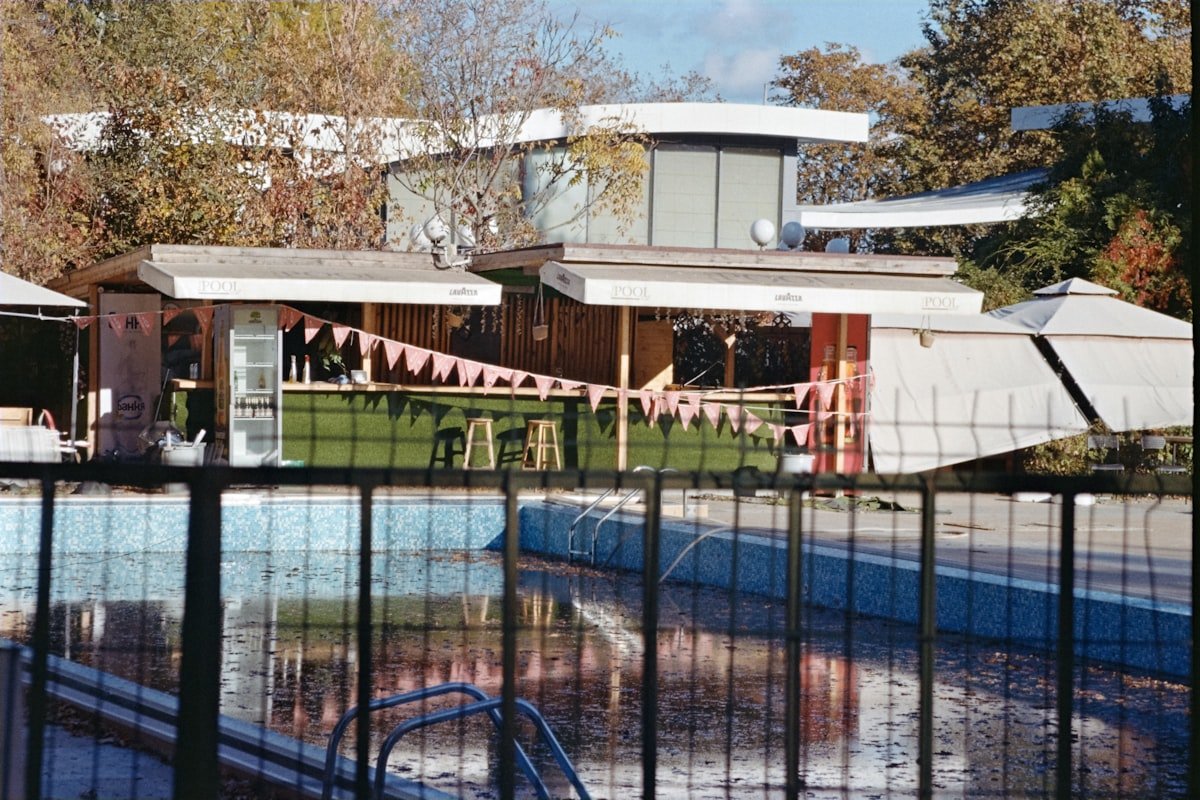
| Type | Best for |
|---|---|
| Removable mesh | Seasonal use, minimal view obstruction, easy to take down for parties or winter |
| Rigid (aluminum, ornamental steel) | Permanent installation, low maintenance, widely accepted by inspectors |
| Glass panel | Preserving sightlines and a modern look, at a higher cost |
| Existing yard fence (repurposed) | Saving cost, if it already meets height, gap, and gate requirements |
See our fence material guide for a deeper comparison of aluminum, steel, and other rigid fencing options if you're leaning that direction.
Self-closing gates: the most common failure point
Even a fence that's technically the right height often fails an inspection — or fails to actually keep a toddler out — because of the gate. A proper self-closing gate uses a spring hinge strong enough to fully close and latch from any open position, not just when nudged shut, and the latch release should sit high enough that a small child can't reach it even by standing on the gate frame. Testing the gate by opening it partway and letting go — rather than assuming it works because it closes when pushed — is the simplest way to catch this before it becomes a real hazard.
Isolation fencing vs. perimeter fencing
A fence around the full yard perimeter only stops entry from outside the property — it does nothing if a door or side gate from the house is left open. Isolation fencing, which separately encloses just the pool area itself, is generally considered the safer configuration by child-safety advocates because it adds a barrier even when the rest of the yard is freely accessible. Where budget allows, many pool owners use both: a perimeter fence for general property security, and a dedicated isolation fence directly around the pool.
Before you install or hire someone
- Does this fence and gate meet my specific state and local code, not just a general guideline?
- Is the gate self-closing and self-latching, and does it actually close from a fully open position?
- Do any doors leading to the pool area need an alarm under my local requirements?
- Does my area require a permit or inspection before the pool can be used?
- If I'm repurposing my existing yard fence, does it meet the height and gap requirements as-is?
Estimate the cost of a compliant fence
Our calculator covers aluminum, ornamental steel, and other rigid fencing styles — enter your pool area's perimeter to get an itemized cost estimate.
Open the free calculator →Frequently asked questions
How tall does a pool fence need to be?
Widely adopted model codes commonly require a minimum height of 48 inches (4 feet) for a residential pool barrier, though some states and municipalities require more. Always confirm the exact requirement with your local building department.
What is the maximum gap allowed in a pool fence?
Common model code provisions limit both the gap between vertical fence members and the clearance between the fence bottom and the ground to no more than 4 inches, sized to prevent a young child from squeezing through or climbing under.
Does a pool fence gate need to self-close?
Yes, under widely adopted code provisions, pool gates are commonly required to be self-closing and self-latching, with the release mechanism mounted high enough to be out of a young child's reach. This is one of the most common points of failure in DIY installations and safety inspections.